PLAY

jay farrer and benjamin gibbard

Audio Player

Monday, June 16, 2014

DAY 9- Versailles, June 10th, 2014

Ah, Versailles! It sounds so nice and we all want to live there, strolling among the Gardens in our best strolling attire, admiring the statuary, the nymphs, the fountains, the occasional peacock, did I mention the nymphs? Drinking sherry......wait where is my sherry? Sacre bleau! where are the servants? why is it suddenly raining?


Actually, Versailles is highly over-rated. True, it's scale is impressive and the buildings are grand and I understand that there is all kinds of lavish and ornate stuff inside those buildings (15 € to stand in line to get into the Palace). 


We opt for the Gardens (9 €).
 
The problem with Versailles is that it is not "public", in that you have to travel a long ways from Paris and pay to get in....ok to visit but not a place to hang out at. I guess it was better in the 17th century with all those servants and gardeners.


Fun Fact:  Construction of the palace, based on existing records, cost 116,438,892 livres. This is equivalent to about $2 billion today. This massive cost does not include the cost of human lives, which was great.

Sunday, June 15, 2014

blog rant

Google of course has the free Blogger, so it is convenient particularly if you already have a Gmail account. However, Blogger’s “features” or lack thereof make it difficult to create and post a well-designed blog. Did I mention Blogger was free, so why am I complaining?

There are all kinds of free applications out there many of which work quite well. Is it too much to ask of Google- giant corporation worth billions, innovative developer of driver-less cars, space elevators, internet blimps, god knows what else- to offer a decent blog app that reflects their creativity?

DAY 8- Notre Dame and Left Bank, June 9th 2014

 Jeez, its June 15th, only a week behind on the freaking Blog........


Went down to the river (Seine) to see Notre Dame cathedral

One of the so called high Gothic cathedrals, “high” because they are so darn huge with towering towers and flying buttrii and quadripartite vaulted ceilings that are so way, way up there, that you yourself tend to get “high” when staring upward so much as in a rare form of airsickness.


Back on the ground, we cross the "bridge of locks" where one sees thousands of locks attached to bridge railings. "The Pont des Arts bridge over the Seine River is a popular tourist destination where couples declare their undying love for each other by writing their initials on a padlock, fastening it onto the bridge, and throwing the key into the water below."

That is so romantic and also sounds sorta dangerous. What about dead load people? In fact last Sunday evening a section of bridge railing collapsed (more like fell over) under the weight of all the locks. Thanks to Tom for that tidbit!


Now that we have safely crossed the scary bridge we are on the Left Bank which is not the Right Bank obviously. Not sure how the left and right banks were determined but the Left Bank is on the south side of Paris and historically was considered the Paris of artists, writers and philosophers. Can you say "Lefty"?


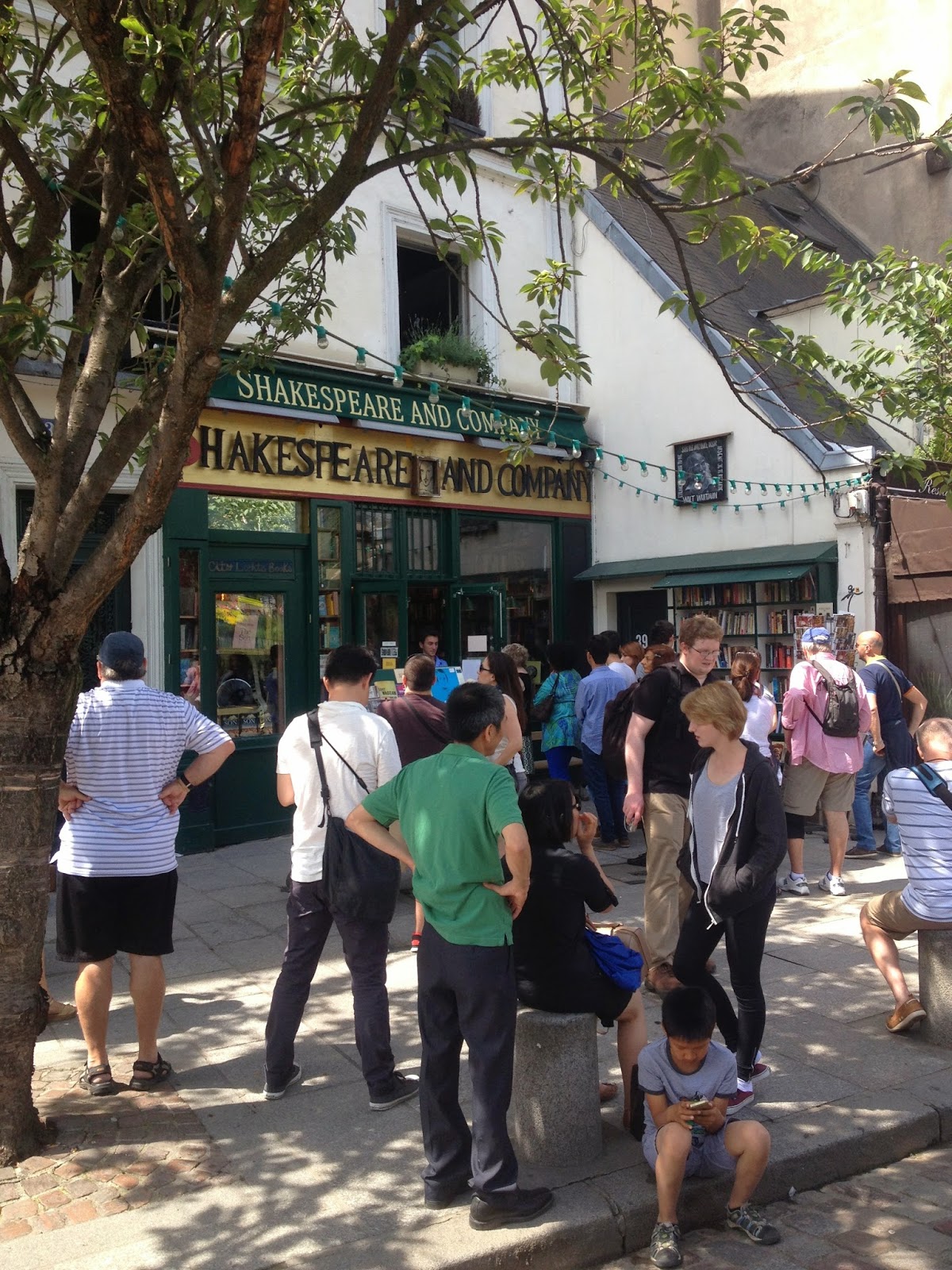
One of the places the Leftys may have hung out was the Shakespeare and Company Bookstore, which we couldn't get into because of the long line....never seen a line for a bookstore except for that time in Nashville when Ted Nugent was autographing his cook book "Kill It and Grill It". He is decidely not a Lefty. But, I digress.

Next is a very impressive statue of archangel Saint Michel slaying some demon. It is huge in scale, measuring 26 meters high and 15 meters wide (85 x 49 ft). The statue was dedicated in 1860 around the time when demons were slowly being replaced by Leftys.


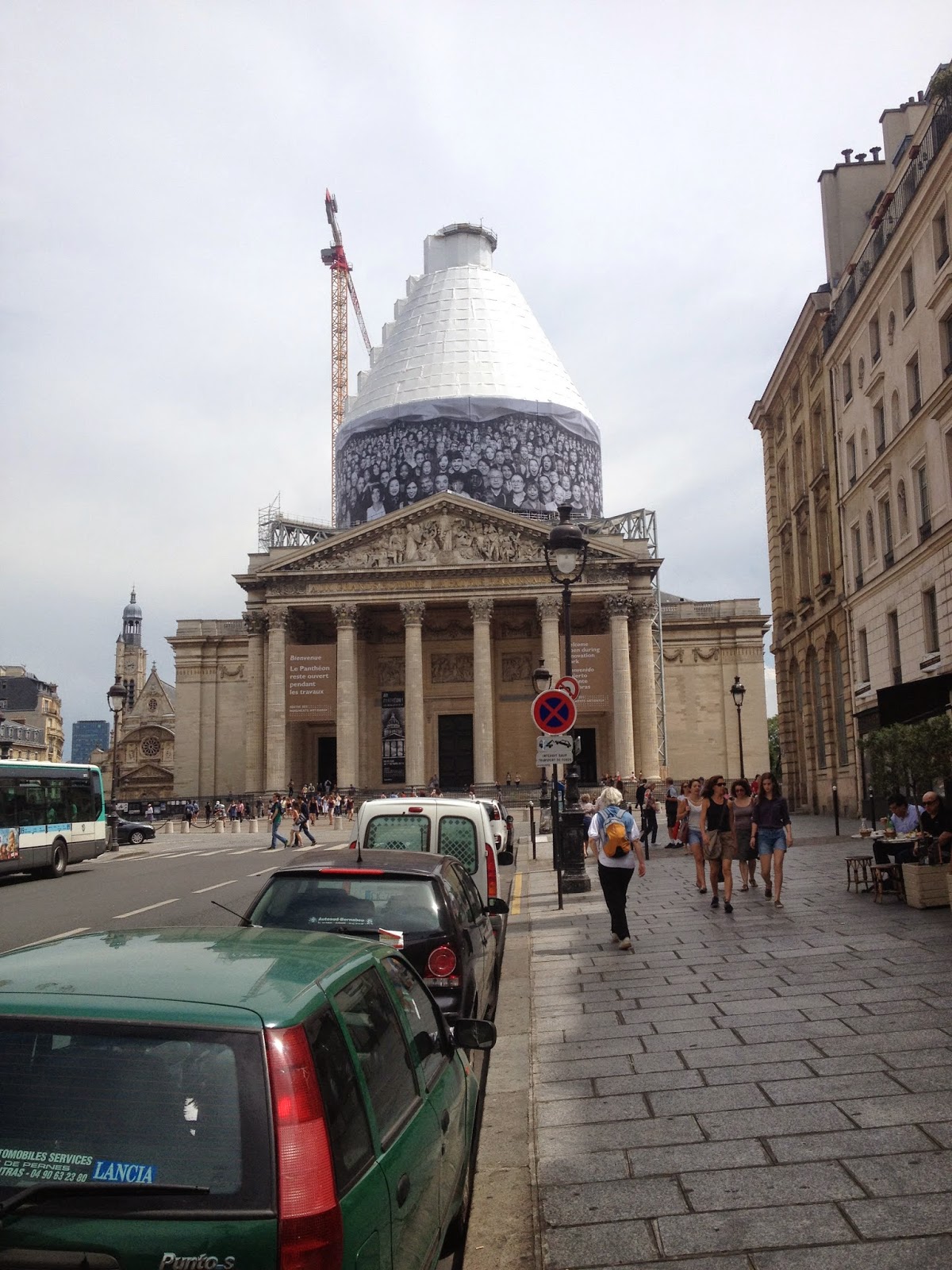
Finally, practically down the street past some medieval looking ruins and then the Sorbonne (Lefty central-Google Sorbonne, May 1968), we come to the Paris version of the Pantheon, an early example of neoclassicism, with a façade modeled on the original Pantheon in Rome. It is currently undergoing a 10 year renovation.


Prof. Taze drags us around to a few more sights until everyone is burnt. Did I mention that Prof. Taze's wife, 3 sons, and mother-in-law are along for the trip? Talk about fool-hardy and misadventurous. But our roving gang of Architects and Landscape Architects stick together and never back down from fool-hardy misadventures.


Thursday, June 12, 2014

DAY 5, 6, 7- June 6th thru 8th

Its now Day 11 or 12 or whatever, so its time to get caught up. Last weekend's activities included visits to the cathedral at Saint Denis, Giverny, home of Monet, and last but not least, the "sacred" grave of Jim Morrison.

Day 5, Friday June 6th
.....took the Metro up to St. Denis (about 8 miles north of Paris) to see what is generally regarded as the first Gothic cathedral. St. Denis is kind of dense (just like Paris) but seemed a little run down (at least the little we saw of it). A cursory search of Paris demographics reveals that St. Denis is on the order of 50% immigrant population, an indicator of the problems of world-wide movements of people into Europe and the United States. One of the first things we noticed were sounds that one might associate with Muslim culture, calling to the Friday prayers perhaps.

We talked with a lady in a coffee shop (we think she was the owner) and she lamented that "she was here against her will".

But we are here to see a cathedral:


Day 6, Saturday June 7th
....took the train to Giverney, about a 45 minute crowded ride (Note to future riders of trains in France- go 2nd class 'cause people sit anywhere. We had 1st class tickets, but there were no seats! Had to scrounge for a seat for the first 20 miles or so)

hey, that's Monet!


Salades!


Day 7, Sunday June 8th
Not much going on today so we Metro over to the largest cemetery in Paris, Père Lachaise, (110 acres).....Puts the New Orleans cemeteries to shame .


Of course I came to see the grave of poor Jim Morrison. Pretty much what I expected.....about a dozen or so "mourners" yucking it up. I believe Morrison made a fateful wrong turn that started him down the path to this end, when he attended that semester at FSU. Bad Tallahassee karma.
 

Wednesday, June 11, 2014

DAY 4- Thursday June 5th

The Day 4 experience is up in the student's neck of the woods.....in other words, the field trip is close to their "hostel" so they can sleep in later and have more recovery time from whatever the heck they were doing the night before........

As previously mentioned, at the Pompidou Center we saw the fine Bernard Tschumi exhibition with some nice drawings of Parc de la Villette, which is our destination.

The Parc was built on the site of the largest slaughterhouse in Paris (via Napoleon III as part of the redevelopment urban plan in 1867). Not exactly the ideal site. The slaughterhouse was relocated in 1974. Tschumi, a Swiss-born French architect, won the design competition in 1982-1983.

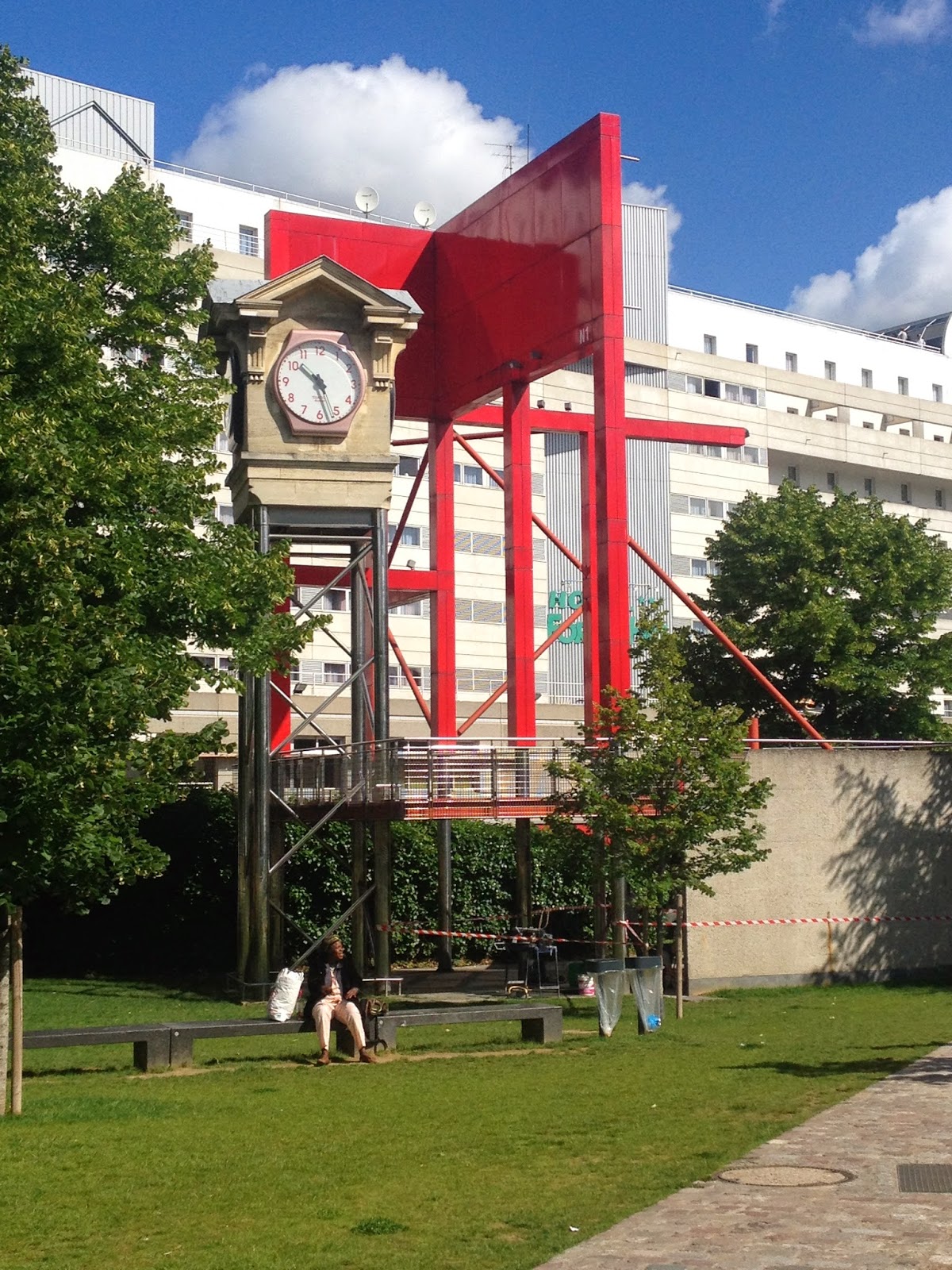
Thirty-five follies (red squares on the plan at left) are placed on a grid and offer a distinct organization to the park. The grid points are placed at 120 meter (393.6 feet) intervals that serve as a common denominator to the entire park. The follies are based on 10x10x10 meter cubes and can be expressed or configured in many different ways within the cubic volume. Architecturally, the follies are meant to act as points of reference that help visitors gain a sense of direction and navigate throughout the space.

Free standing icons, "the follies act as architectural representations of deconstruction. In architecture, a folly is a building constructed primarily for decoration, but either suggesting by its appearance some other purpose, or merely so extravagant that it transcends the normal range of garden ornaments or other class of building to which it belongs. In a deconstructive vacuum without historical relation, many have found connections between the steel structures and the previous buildings that were part of the old industrial fabric of the area. Today, the follies remain as cues to organization and direction for park visitors." 
-quote, some stuff on the Internet-


Hot Dog! We now have ourselves not only Post-modernist, but DeconstructionistTschumi, who I could have sworn on Day 3 was a post-modernist, believes that Deconstructivism is simply a move against the practice of Post-modernism, which he said, and I am not making this up, involved "making doric temple forms out of plywood". 

Tschumi designed the Parc de la Villette with the intention of "creating a space that exists in a vacuum, something without historical precedent. Visitors view and react to the plan, landscaping, and sculptural pieces without the ability to cross-reference them with previous works of historical architecture. By allowing visitors to experience the architecture of the park within this constructed vacuum, the time, recognitions, and activities that take place in that space begin to acquire a more vivid and authentic nature. The park is not acting as a spectacle; it is not an example of traditional park design such as New York City’s Central Park. The Parc de la Villette strives to act as merely a frame for other cultural interaction." -quote, some more stuff on the Internet-


Let us sum up or "deconstruct', as it were, the above:  what this all means is that the average "visitor" is clueless and not at all concerned about "cultural interaction" and "vivid and authentic nature"; rather the visitor is looking for the playground to drop off the kids in order to commence an extended search for beer. Meanwhile, intermittent roving bands of "post-modernists", disturbed, and oddly attracted to Tschumi's vision, search for meaning among the follies.


There have been many criticisms of the park since its original completion. To some, the park has little concern with the human scale of park functions and the vast open space seems to challenge the expectation that visitors may have of an urban park.

http://www.pps.org/great_public_spaces/one?public_place_id=369

]

Monday, June 09, 2014

DAY 1- Monday June 2nd, 2014

Lets see, Day 1 in Europe was like 2 days ago, but here is how it went:

We got on a plane (actually Day Zero) with Prof. Taze, his wife, 3 kids (boys), and 10 Landscape Architecture students, at Greater Starkville/Columbus International Airport (2 gates), flew to Atlanta for the highlight of the flying experience, an excellent Open Face Meatloaf Sandwich w/ sauteed spinach, bacon, pimento cheese, and barbeque sauce, at a really nice restaurant- who would have thought in Georgia? the Atlanta airport is like a foreign country....

Then followed the 8 hour flight to Paris, which to me, not having flown much lately, seemed more like 12 hours. But they did try to serve us some food along about midnite......We declined the weird looking chicken?


Got in to Paris and Surprise! its 2PM and its DAY 1. Made it thru customs, got the suitcase, coordinated with Prof. Taze and the students, hit the Metro, transferred at Chatelet Les Halles (more like Chatel of Hells)
Spent 30 minutes trying to figure out where the connecting line was, found that, got off at our stop (Auber), and then could not figure out how to get to the SURFACE! Finally asked a nice lady and she led us to daylight....found the apartment (more on that later), found beer and wine, crashed.

DAY 2 soon......


DAY 3- Wednesday June 4th

Its now Day 6 or 7 and I am writing about Day 3. Confusing? Not to me:

Day 3 is Post-Modern Day! 

After walking from our apartment in the rain for 2.4 kilometers we assemble- me, Leslie, Prof. Taze Fulford- in the plaza of the Pompidou Center, the famous, much reviled and misunderstood (whats to understand?) monument to post-modern architecture. 

“Dave, what the heck is post-modern?" its what comes after modern, silly. Basically.....


"modernism is the enlightenment-humanist rejection of tradition and authority in favour of reason and natural science. This is founded upon the assumption of the autonomous individual as the sole source of meaning and truth--the Cartesian cogito. Progress and novelty are valorized within a linear conception of history--a history of a "real" world that becomes increasingly real or objectified. One could view this as a Protestant mode of consciousness."

"Whereas postmodernism is a rejection of the sovereign autonomous individual with an emphasis upon anarchic collective, anonymous experience. Collage, diversity, the mystically unrepresentable, Dionysian passion are the foci of attention. Most importantly we see the dissolution of distinctions, the merging of subject and object, self and other. This is a sarcastic playful parody of western modernity and the "John Wayne" individual and a radical, anarchist rejection of all attempts to define, reify or re-present the human subject."
I hope that clears the air.

 The students arrive late due to their being students. No, actually they had Metro issues, train broke down or something. Since the Pompidou opens for free admission at 2pm, we scout around the area for interesting “social spaces” including the requisite water features, trees, plants, materials, details, spatial organization, context, etc. In other words, landscape architecture…….

Next door to the Center is Stravinsky Fountain which is highlighted by a pool full of "whimsical" kinetic sculptures- unfortunately the pool was drained and the sculptures were not acting in a kinetic manner. Across from the pool is a wall-o-graffiti highlighted by the giant face of Salvador Dali. Is he shushing the medieval church next door? Isn't he dead? And where is John Wayne? Good lord! Could this be a post-modern moment?


We wander for a few blocks to the Fontaine des Innocents; much sketching ensues……


After lunch (a fine omelet with excellent cheese of course) we visit the construction site of a major re-development of the les Halles area into a giant covered retail and cultural center. Dare I say it? Post-modern, right down to the on-site worker housing….

Its 2pm so we go back to the Pompidou Center for our free admission. You saw the exterior in the photo(s) above- the interior sort of reminded me of a gigantic AgExpo, only with people instead of cows, pigs, etc. Kind of a letdown from the imposing P-M exterior with its exposed structure, mechanical systems and circulation. While inside we did see an interesting exhibition which, low-and-behold, included the very site we were to visit on Day 4. Way to go Prof. Taze! The exhibit featured the work of Bernard Tschumi, famous……....(wait for it)……......post-modernist!  The project of note was parc de la Villette, a design that Tschumi executed, and which was constructed in the 1980’s…….. 

more on that, Day 4!