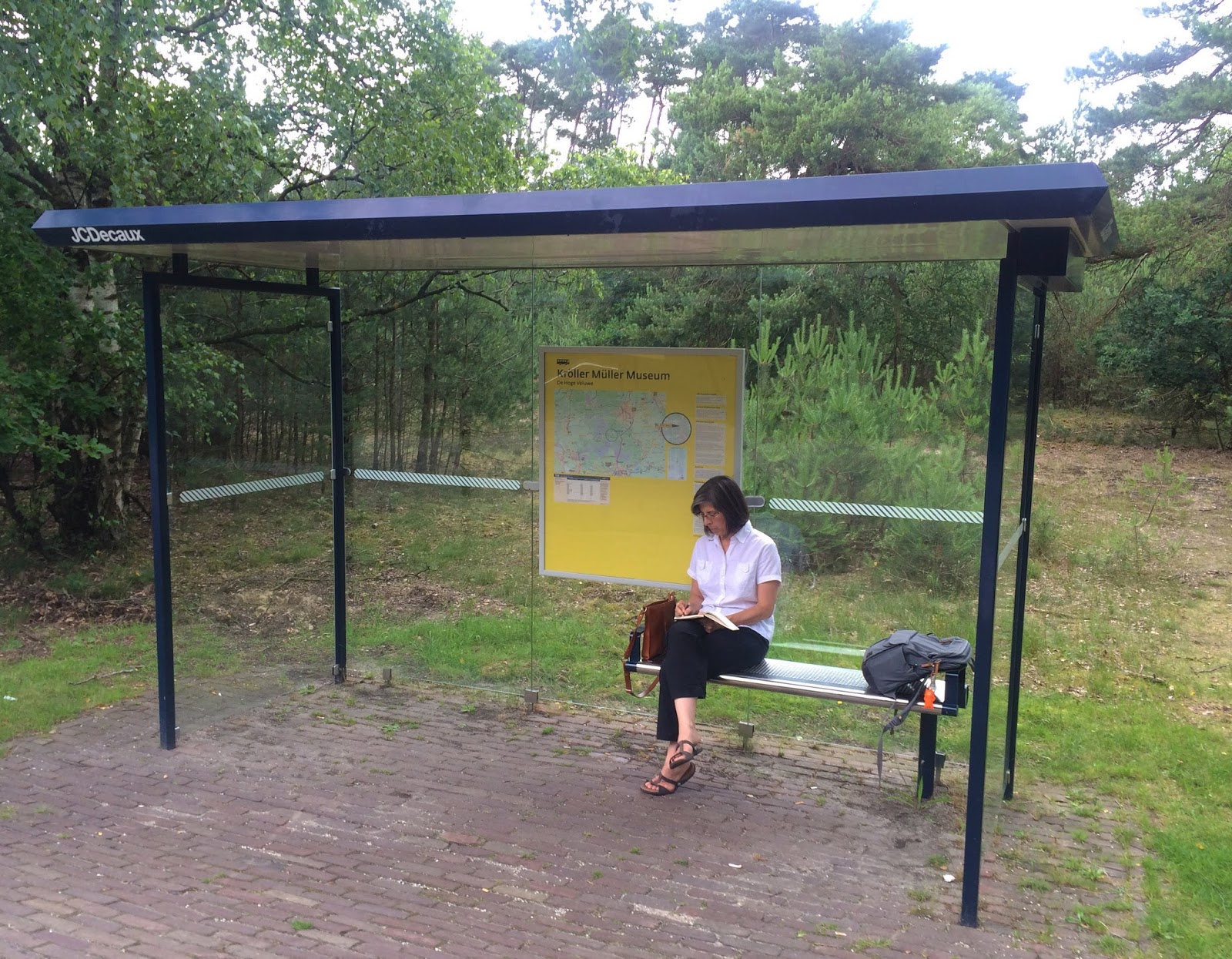
The Kröller-Müller Museum is an art museum and sculpture garden, located in the Hoge Veluwe National Park near Arnhem (Its in the middle of a forest). The museum was founded by art collector Helene Kröller-Müller and opened in 1938. It has the second-largest collection of paintings in the world by Vincent van Gogh.
In Malaga, June 18......climbed the big hill to the top of theAlcazaba which is a palatial fortification in Málaga. It was built by the Hammudid dynasty in the early 11th century.This is the best-preserved alcazaba (from the Arabic al-qasbah, meaning "citadel") in Spain. Adjacent to the entrance of the Alcazaba are remnants of a Roman theater
dating to the 1st century BC, which are undergoing restoration. Some of
the Roman-era materials were reused in the Moorish construction of the
Alcazaba.
The Alhambra takes its name from the Arabic al-qala’a al-hamra (the Red
Castle, the Red One, the Red Fortress, etc.). Its on my tee-shirt!
The first palace on the site was built by Samuel Ha-Nagid, the
Jewish grand vizier of one of Granada’s 11th-century Zirid sultans. In
the 13th and 14th centuries, the Nasrid emirs turned the area into a
fortress-palace complex, adjoined by a village of which only ruins
remain. Completed towards the end of Muslim rule of Spain by Yusuf I (1333–1353) and Muhammed V, Sultan of Granada (1353–1391), the Alhambra is a reflection of the culture of the last centuries of the Moorish rule of Al Andalus (Muslim Spain), reduced to the Nasrid Emirate of Granada.
It is a place where artists and intellectuals had taken refuge as the
Reconquista by Spanish Christians won victories over Al Andalus.
After the Reconquista, the Alhambra’s
mosque was replaced with a church, and the Convento de San Francisco
(now the Parador de Granada) was built. Carlos I (also known as the
Habsburg emperor Charles V), grandson of the Catholic Monarchs, had a
wing of the palaces destroyed to make space for his huge Renaissance
work, the Palacio de Carlos V.During the Napoleonic occupation, the
Alhambra was used as a barracks and nearly blown up. What you see today
has been heavily but respectfully restored.
....in Florence Alabama, and I didn't even make it thru reports on Spain and the return to Amsterdam on 6/19. Some recaps are in order and will be posted forthwith......
The Cathedral of Málaga was the most impressive church we saw on the trip.
A Renaissance church with a Baroque facade, it was built between 1528 and 1782 on or near the site
of a former mosque. It is located within the limits defined by a now missing portion of the
medieval Moorish walls, the remains of which surround the nearby Alcazaba and the Castle of Gibralfaro. While original plans had allowed for
two towers, lack of funds resulted in the completion of only one, giving rise to the name by
which the cathedral is affectionately referred to, La Manquita, loosely interpreted as "one armed woman".